Set up a Survey
From an empty form to a Survey people can answer, in six steps. We’ll use a Survey about the old trees of a city as the example.
Step 1: Create the Survey
Click the + button in the top menu and pick Survey.
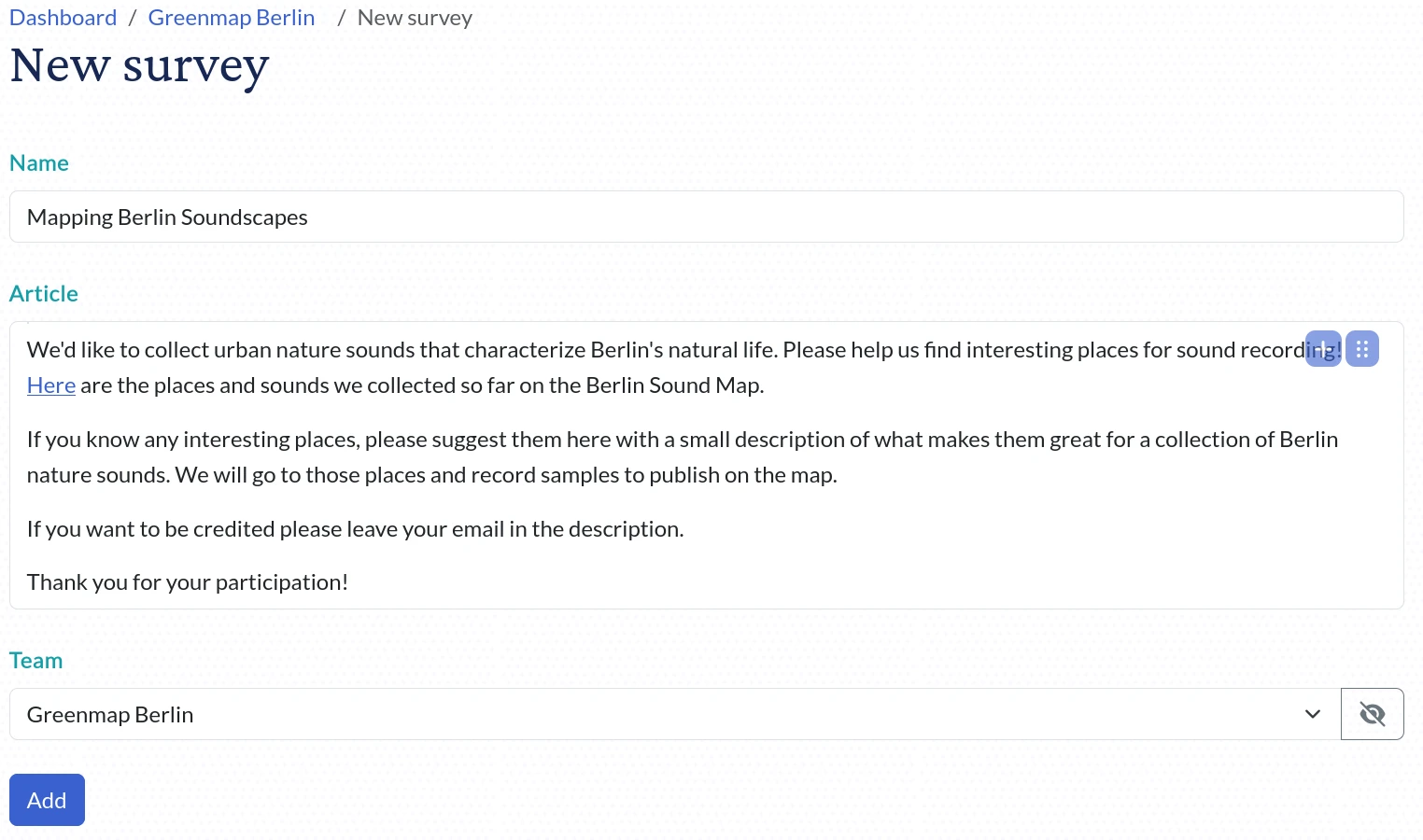
Give it a name, pick the team that runs it, and write a short article about your project. This article opens the form, so tell people what you are mapping, why it matters, and how their knowledge helps. Press Add, and the Survey opens in the form editor.
The form editor shows your Survey the way contributors will see it. Click a question to change it, or click an empty spot next to the questions to change the Survey itself. Later on, you get back to it with the Form editor button on the Survey’s dashboard.
Step 2: Add a cover and choose the map
Click an empty spot in the preview, so the panel shows the settings of the Survey.
- Under Identity, pick a cover picture. Use a photo from the place you are mapping rather than a logo: it’s the first thing people see, on the form and wherever you share it.
- Under Map, pick the map that receives the answers.
Step 3: Choose the icons
Icons tell what kind of place each site is, and there are two ways to give them to a site:
- Icons on every answer are added to every site from this Survey. Contributors don’t see them. For the old trees, pick Special Tree here, so every answer is a tree without anyone having to say so.
- The icons question lets contributors pick from a list you choose. For the old trees, that list could describe where the tree stands: a park, a street, a backyard. Keep the list short, so people can choose quickly.
If an icon has its own questions, they appear in the form as soon as it’s added to an answer.
Step 4: Shape the questions
A new Survey already has the questions every site needs: where it is, what it’s called, what it is, which icons fit, pictures and sounds. You can reword them or hide the ones you don’t need, but you can’t delete them.
- Location: choose how people can place the site. GPS is the fastest when they stand in front of it. Keep allow manual on as the way out when the rest fails.
- Name: if your sites don’t have real names, hide this question and set a feature name prefix in the settings instead. Every old tree then gets a name like Old tree 602f9d16…, which keeps the map easy to browse.
- Description: ask for what you actually want to know, like What makes this tree special?, instead of a plain Description.
- Pictures: ask for photos the contributors took themselves. You need the right to publish a picture on your map.
- Sounds: hide it if a recording makes no sense for your project.
Add your own questions with the + buttons around a question, and pick the type that fits the answer. Questions about the contributor, like their email, go in their own group at the end. Their answers stay with your team and are never published on the map.
Mark a question as required only when you really can’t accept a blank. Every required question is one more reason for someone to give up halfway.
Step 5: Decide when and how people answer
In the settings of the Survey:
- Under Schedule, set a start date and an end date if your Survey belongs to an event or a campaign. Leave them off to keep it open.
- Under Answers, turn on registration mandatory only if you need contributors to sign in. Anyone can answer without an account otherwise, and more people will.
- Turn on notifications so your team gets an email for every new answer.
Then press Save in the heading of the editor. Nothing you changed is kept until you do.
Step 6: Test it and go public
Under Visibility, turn on is public and save again. Your Survey can now be answered by anyone with its link.
Before you announce it, open the Survey’s public page and send an answer yourself, the way a contributor would. You’ll see if a question is confusing or if a required question blocks the send button, and you can check that the answer reaches your team. You can reject the test answer afterwards.
Then get the word out. Make a short web address or a QR code for the Survey, use the cover picture on social media and posters, tell the local news and radio, or run a mapping event. As answers come in, review and publish them.